
Skilled Trades Have Changed—Training Hasn’t Caught Up
The workforce that automation demands—technical, adaptive, cross-functional—doesn’t come from corporate programs. It comes from specialists with 20 employees.

This post draws on an ongoing conversation with Craig Desmond, a carpenter with over two-decades of experience and the owner of Ecotone — a design-build firm focused on creating spaces for human wellness. Craig has a deep passion for developing people and processes through hands-on experience. Ecotone has moved from sponsoring formal apprenticeship programs to integrating ‘apprenticeship’ across all aspects of its work. Our conversations span cultural narratives around skilled trades, the failings of traditional training programs, and the integrity that comes from building physical environments.
Our future as builders of productive assets is no longer one of blue-collar tradesmen and women executing plans drawn up by men in starched collar shirts. We are entering an era where conceptual-analytical, technical-digital, and manual-craft skills are table stakes in the ‘new-collar’ economy.1
Roughly 400,000 skilled trade jobs are unfilled in America, according to the Bureau of Labor Statistics. By 2033, it’s estimated that number could hit close to 2 million, according to Deloitte and the Manufacturing Institute.2
In the United States of America, we face a historic generational skills gap: the talent pipeline for the skilled trades is failing to produce enough workers to enter the trades, and the tradespeople is produces often lack the skills the industry needs to regain its footing and compete globally. Nearly one in four tradesmen is already at retirement age, meaning the skills gap is about to widen rapidly, and the knowledge held in their hands and minds will disappear from our collective knowledge base with them.
Getting the answer to this problem right could not be more important.

(A "bottom up" view of the sub-fabrication floor at Global Foundries, Malta, New York. Image courtesy Christopher Payne.)3
The construction industry already has the solution, though, and given the right tools, will start to close the gap. A different model than traditional corporate training programs and apprenticeship models is succeeding: the 25-person steel fabricator, the specialized rigging firm, the small MEP contractor, and the design-build carpenter who integrates ‘apprenticeship’ into their firms' culture out of necessity. These firms aren’t just building NYC and our country—they’re building the workforce that builds, and they are doing it with a high degree of efficacy. The problem is that policy treats them as afterthoughts rather than the training powerhouses they actually are.
Key Points
The skills gap isn’t only about quantity—it’s about hybrid competence. Modern trades require CAD fluency, robotic operation, and craft skill simultaneously.4
A new hire at a 25-person firm touches estimating, fabrication, and client work in year one. Corporate trainees or apprentices spend that year in orientations.
Small firms absorb every training dollar directly, while larger firms or unions can amortize costs across thousands of people. Same tax code, radically different burden.
NYC construction already runs on specialized small firms: 91% employ fewer than 20 people. The policy question is whether we support that structure.5
Training credits, shared facilities, and portable benefits are how we unlock the workforce development engine we need to close our generational skills gap.
Small Firms Are Where New Collar Talent Gets Made
The construction industry’s workforce shortage isn’t about warm bodies—it’s about hybrid competence. Every trades employer in New York can tell you they’re hiring. Fewer can tell you they’re finding workers who can program a CNC plasma cutter in the morning and troubleshoot an installation problem onsite in the afternoon. That combination of digital fluency and physical craft is the new baseline, and the pipeline isn’t producing it.
Modern trades work demands fluency across domains that didn’t exist together a decade ago. A steel fabricator now needs to move seamlessly between CAD/CAM programming, operating robotic equipment, traditional welding and fitting skills, and adaptive problem-solving when drawings don’t match field conditions. A rigger needs to understand load calculations in software, operate increasingly sophisticated equipment, and make real-time judgment calls that no algorithm can replicate. The “skilled” in skilled trades has been redefined, and the definition keeps expanding.
Traditional training pipelines were built for a different era. Union apprenticeships, vocational programs, and community college certificates all emerged when trades work meant mastering a defined set of physical techniques. They struggle to keep pace with technology adoption at the firm level, not at the curriculum committee level. These same programs have also now become gatekeepers and rate limiters on the number of new tradespeople entering the talent pipeline. Union apprenticeship programs have rigid trainer-to-trainee ratios, set in an era of robust hiring and training, which now create an increasingly shrinking talent pool. Even if traditional models kept pace in quantity by the time a training program incorporated new software or equipment, the industry had already moved on. Craig Desmond, who runs Ecotone, a design-build firm in New York, spent 15 years building formal apprenticeship programs—weekend training, youth pathways, and structured skill-building initiatives—and found them to be intense, expensive, and difficult to sustain. The business grew organically; the training program required constant campaigning.
The gap between what gets taught and what gets used widens every year. The gap between who gets taught and who we need in the skills trades follows the same trendline. It’s a one-two punch that, left unchecked, will continue to gut our industry and leave it uncompetitive.
Small Firms Are Workforce Development Machines
The structural advantages of small firms for workforce development are right in front of us if we choose to pay attention. We’ve spent decades assuming that scale equals capability—that the companies and unions with dedicated training departments and custom learning management systems must be producing better workers. The evidence from the construction industry suggests the opposite.
At a 25-person firm, a new hire touches every phase of production within their first year. They're estimating jobs, programming cuts, running equipment, checking quality, coordinating with installers, and fielding client calls—often in the same week. The learning isn't theoretical; it's immediate and consequential. A company with 20 employees can't afford to have workers who know only one thing. Cross-functional exposure isn't a training philosophy at these firms—it's survival.
Cross-functional exposure is built into the small-firm business model. A company with 20 employees can’t afford workers who only know one thing. Everyone covers for everyone.6 This dynamic comes through very clearly in another Range NYC post, "Cross-Training and Simplicity Beat Scale in Manufacturing." What makes this work isn't a program. It's an operating system. Tasks are structured as learning opportunities. Problems are treated as training moments rather than failures. Feedback is constant because the consequences of not giving it are immediate. The fabricator who understands installation problems makes fewer fabrication mistakes. The project manager who runs equipment understands what’s realistic to promise. This isn’t a training philosophy—it’s survival. And it produces exactly the adaptive, cross-functional workers the industry needs.
The feedback loop between performance and consequence is immediate in ways that corporate training can’t replicate. When you make a mistake at a small firm, you see it affect your colleagues and the quality of work immediately; you have real skin in the game, real accountability, and your peers hold you to account. You fix it yourself. There’s no abstraction layer between your work and its impact. That accountability accelerates learning faster than any simulation or case study.
Desmond describes this as training that dissolved into Ecotone's standard operating procedures. Mentorship and skill-building stopped being an add-on and became the way the firm operates on every job—developing the entire team, from foremen to designers to project managers. The documentation developed to teach installers now teaches clients. The firm didn't abandon workforce development. It stopped treating it as separate from the work itself.
Craft scales through modeling, correction, and incremental mastery—not through classrooms.
The Policy Gap That Holds Small Firms Back
Despite their training advantages, small construction firms compete for talent with one hand tied behind their back. The policy infrastructure that supports workforce development was designed for a different kind of employer—and a different kind of training.
Large corporations and unions can amortize workforce development costs across thousands of employees. When IBM or the International Brotherhood of Electrical Workers (IBEW) invests in training infrastructure, the cost is spread among hundreds of thousands of workers. When a 20-person rigging firm invests in the same training, every dollar comes directly out of margin. The economics aren’t just different in degree—they’re different in kind. Small firms face a structural penalty for doing exactly what the industry needs them to do, and it’s time to flip the script.7
The deeper mismatch is in what policy recognizes as training. Workforce development funding, tax incentives, and credentialing systems are all built around formal program structures: classroom hours, institutional partnerships, credentialed completions. Those models work for large organizations. They are not the models that produce skilled workers at small firms.8 Desmond ran formal programs for 15 years—and while they weren't wasted, they were unsustainable precisely because they replicated institutional structures that a small commercial firm couldn't carry. What proved durable was the culture built during those years: every task a learning opportunity, every problem a training moment, every project structured for growth. Policy doesn't have a line item for that. It should.
The specific policy gaps compound each other: tax treatment that favors capital investment over human capital investment means firms get better write-offs for equipment than for the people who operate it; benefits structures penalize small employers who can’t negotiate group rates; training infrastructure is designed for scale, with equipment and facilities that no 25-person firm could justify alone; credential systems privilege formal certifications over demonstrated on-the-job competence. Each gap is manageable individually. Together, they constitute a systematic disadvantage.
What Leveling the Field Would Look Like
Supporting small-firm workforce development doesn’t require reinventing policy—it requires redirecting it toward what actually works, rather than replicating formal program structures that don’t survive contact with the economics of a 20-person firm.
Tax credits for training investments, modeled on R&D credits, would allow small firms to treat workforce development as the capital investment it is. But these credits need to recognize operational training—not just classroom hours. A firm that structures every task as a learning opportunity, that builds documentation serving both its installers and its clients, that treats problems as development moments—that firm is investing in workforce development every day.9 The tax code should recognize that, just as it recognizes investments in equipment and facilities.10
Shared training facilities, designed with industry input, would give small firms access to advanced equipment and specialized instruction that no 25-person firm could justify on its own. Portable benefits systems would make small-firm employment competitive by pooling risk across multiple small employers, removing one of the biggest barriers to attracting talent without requiring each company to become a benefits administrator.
Peer networks between firms could compress the timeline for building a training culture.11 The journey from formal program to embedded operating system shouldn’t take 15 years. But the operating system that emerges—where feedback is the norm, documentation serves double duty, and every project is structured for growth—is transferable. The industry already collaborates on projects; it should collaborate on talent development as well.
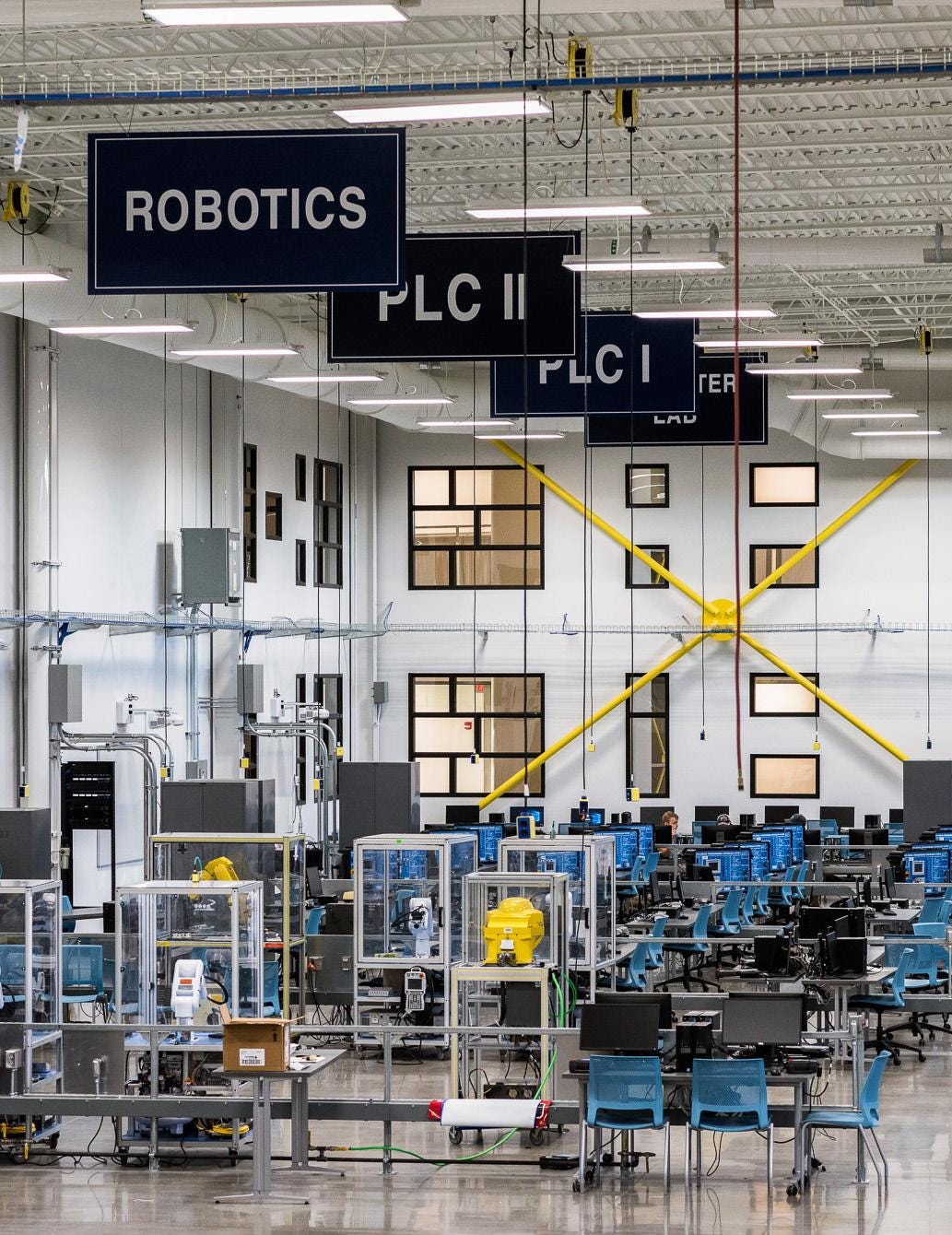
(Image Courtesy of Omni Architects: Leaders in Workforce Training Center Design publication)
NYC’s New Collar Workforce Starts at Small Firms
NYC’s construction industry is already structured around specialized small firms—the policy question is whether we’ll support that structure or fight it. Every major project in the city involves dozens of contractors, each bringing specific expertise to a temporary collaboration. This isn’t a market failure; it’s how complex construction actually works. The fragmented model enables specialization, flexibility, and rapid adaptation that vertically integrated corporations can’t match.
The same fragmentation that makes NYC construction work also makes it a natural engine of workforce development—if we let it function. Small specialized firms adopt new technology faster because they have to; their competitive advantage depends on staying current. They provide more meaningful training because they can’t afford to lose passengers; if everyone doesn't contribute, the firm doesn’t survive. They create career pathways that progress through mastery rather than hierarchy: the best fabricator becomes the shop lead, then the owner.
The industry doesn't need to invent a new training model. It needs to recognize the one that's already working—and that the expensive, unglamorous process of building a training culture inside a small firm is the investment that matters most. What often looks like an anchor on growth turns out to be its foundation. Cities that figure out how to support that process across hundreds of small firms will own the talent pipeline for the next generation of construction.

(Image courtesy of the New Lab Brooklyn)
The Foundation We Already Have
The construction industry doesn’t need to wait for a new generation of training programs to solve its workforce crisis—the solution is already operating across the five boroughs. Small specialized firms are producing the hybrid technical-digital workers that industry demands, not through formal programs but through cultures of continuous personnel development built into daily operations. What’s missing isn’t a model; it’s the policy support to let that model spread. Training tax credits that recognize operational learning, shared facilities designed with industry input, portable benefits that make small-firm employment competitive, and peer networks that enable firms to transfer hard-won training cultures to one another—these mechanisms exist in various forms. The question is whether we’ll deploy them to support how workforce development actually happens.
NYC’s construction industry is built on small specialists. Its workforce policy should be too.
Ever upward.
The term "new collar" was coined by Ginni Rometty, then-CEO of IBM, in late 2016. She introduced the concept in an open letter to President-elect Donald Trump in November 2016, urging support for creating these types of roles.
The "new collar" concept sits between blue-collar and white-collar work roles, requiring specialized technical skills that can be obtained through community colleges, boot camps, certifications, and apprenticeships rather than traditional university education.
CBS News, “Data center demand is booming. Can the supply of trade workers keep up?”, 2025. https://www.cbsnews.com/news/data-centers-skilled-trade-workers-artificial-intelligence/
Image courtesy of Christopher Payne from (https://www.scopeofwork.net/the-honorable-parts/).
Christopher Payne specializes in architectural and industrial photography. Trained as an architect, he is fascinated by design, assembly, and the built form. His first book, New York’s Forgotten Substations: The Power Behind the Subway, offers rare views of the behemoth machines hidden behind modest facades in New York City. Asylum: Inside the Closed World of State Mental Hospitals, which includes an essay by Oliver Sacks, is a journey through America’s abandoned state mental institutions. North Brother Island: The Last Unknown Place in New York City explores an uninhabited island of ruins in the East River, providing a glimpse into a city’s future without people.
Payne’s recent work has veered away from documenting the obsolete toward a celebration of American manufacturing and craftsmanship. Over the past decade, through personal projects and editorial commissions, he has been on a photographic journey to learn more about what’s made here: the traditional industries that “built this country” as well as the newest, most technologically advanced processes. These images can be found in his latest book, Made In America, published by Abrams in fall 2023.
National Skills Coalition and Federal Reserve Bank of Atlanta, “Digital Skills Gap Analysis,” 2023. https://nationalskillscoalition.org/
New York State Comptroller, “The Construction Industry in New York City,” 2025. https://www.osc.ny.gov/files/reports/pdf/report-8-2026.pdf
Range NYC x Cross Training and Simplcity Beat Scale in Manufacturing. https://rangenyc.substack.com/p/cross-training-and-simplicity-beat
Training Magazine, “2024 Training Industry Report,” 2024. https://trainingmag.com/2024-training-industry-report/
Center for an Urban Future, “Making the Connection: Aligning Small Businesses and the Workforce Development System,” 2019. https://nycfuture.org/research/making-the-connection
Aspen Institute, “Worker Training Tax Credit: Promoting Employer Investments in the Workforce,” 2018. https://www.aspeninstitute.org/publications/worker-training-tax-credit-update-august-2018/
U.S. Department of Labor, “State Tax Credits and Tuition Support for Apprenticeships,” 2024. https://www.apprenticeship.gov/investments-tax-credits-and-tuition-support/state-tax-credits-and-tuition-support
SME (Society of Manufacturing Engineers), “Apprenticeship Programs Obtainable for Small Business through Consortium Approach,” 2023. https://www.sme.org/apprenticeship-programs-obtainable-small-business-consortium-approach